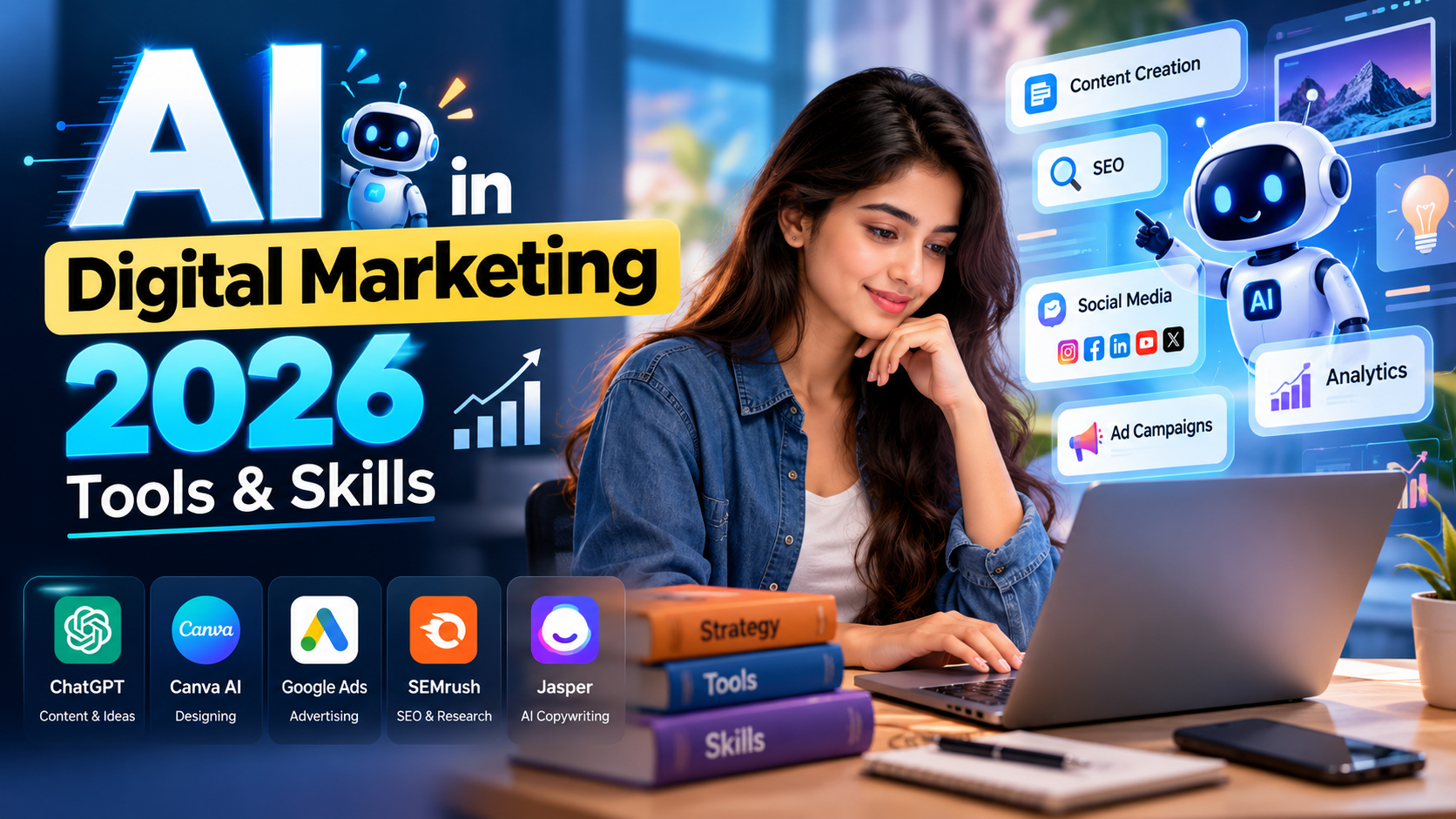
Quick answer: AI in digital marketing means using machine learning and generative AI to research audiences, create content, optimise ads, personalise messages and analyse results faster than manual work allows. In 2026, marketers use AI assistants like ChatGPT, Gemini and Claude for research and drafting, AI built into ad platforms for targeting and bidding, and automation or AI agents for repetitive tasks. Humans still own strategy, brand voice and final judgment.
Key takeaways
- AI has moved from a side experiment to a daily working tool for most marketing teams.
- The biggest gains come from using AI for research, first drafts, testing and reporting, not for replacing strategy or creativity.
- AI agents are the newest shift: they can complete multi-step tasks, but they need clear goals and human approval.
- In India, multilingual and Hinglish content, WhatsApp and local context make human judgment even more important.
- The marketers who win will combine AI skills with core skills like SEO, paid ads, analytics and copywriting.
What is AI in digital marketing?

AI in digital marketing is the use of artificial intelligence to plan, create, run and measure marketing activity. It includes generative AI that writes text, images and video, machine learning built into platforms like Google Ads and Meta Ads, and tools that automate analysis and customer communication.
Think of it as a fast, tireless assistant. It can process large amounts of data, suggest ideas and produce drafts in seconds, but it does not understand your brand, your customers or your business goals unless you tell it.
Why is AI in digital marketing trending in 2026?
Three things changed. First, AI in Digital Marketing is now built into the tools marketers already use every day, from ad platforms and design apps to email, CRM and analytics software, so adoption no longer needs a separate project. Second, teams are under pressure to produce more content and campaigns with the same or smaller budgets. Third, AI search and chat tools are changing how people discover brands, which forces marketers to rethink content and measurement.
In India there is an extra factor. Audiences search and chat in many languages, often mixing Hindi and English. Brands that use AI to understand local intent, and then add real human judgment on language and culture, stand out from generic, copy-paste content.
How do marketers use AI? 8 practical use cases
1. Audience and keyword research
How AI helps: It clusters search queries, summarises customer reviews and surveys, and suggests audience segments and content angles. Human job: Check the data, add real customer insight and decide which opportunities fit the business. Example tools: ChatGPT, Gemini, Claude, Semrush, Ahrefs, Google Search Console.
2. Content creation and SEO
How AI helps: It produces outlines, first drafts, meta descriptions, FAQ ideas and content updates. Human job: Add first-hand experience, verify every fact, match brand voice and edit hard. Google says it rewards helpful, original content however it is produced, but mass-produced low-value pages can fall under its spam policies. Example tools: ChatGPT, Gemini, Claude, Surfer, Semrush.
3. Social media planning and design
How AI helps: It generates post ideas, captions, content calendars, image variations and quick design drafts. Human job: Choose what fits the platform and the moment, protect brand style and review anything that goes public. Example tools: Canva, ChatGPT, Gemini, scheduling tools with AI features.
4. Paid advertising
How AI helps: Platforms use AI for audience targeting, bidding, creative testing and budget allocation, for example in Google Ads campaigns such as Performance Max and Meta’s Advantage+ campaigns. AI can also write and test ad copy variations. Human job: Set clear conversion goals, supply strong creative and first-party data, and watch for wasted spend. Example tools: Google Ads, Meta Ads Manager.
5. Email and WhatsApp marketing
How AI helps: It personalises subject lines and messages, segments lists, suggests send times and powers WhatsApp chatbots that answer common questions. Human job: Respect consent and privacy rules, keep messages relevant and avoid over-messaging. Example tools: Mailchimp, Brevo, HubSpot, WhatsApp Business platform providers.
6. Analytics and reporting
How AI helps: It summarises dashboards in plain language, flags unusual changes and drafts weekly or monthly reports. Human job: Decide what the numbers mean for the business and what action to take. Example tools: Google Analytics 4, Looker Studio, spreadsheet tools with AI assistants.
7. Chatbots and customer support
How AI helps: It answers frequently asked questions, collects lead details and routes complex queries to people, any time of day. Human job: Write accurate answers, set clear limits on what the bot may say and make it easy to reach a real person. Example tools: Website chat tools, WhatsApp chatbots, CRM platforms with AI features.
8. Lead scoring and CRM follow-up
How AI helps: It ranks leads by likelihood to convert, drafts follow-up messages and reminds teams when a lead goes cold. Human job: Review the scoring logic, personalise high-value conversations and keep CRM data clean. Example tools: HubSpot, Zoho CRM, Salesforce.
AI assistant vs marketing automation vs AI agent: what is the difference?
An AI assistant responds to your prompts, marketing automation follows fixed if-then rules, and an AI agent plans and completes multi-step tasks toward a goal with limited supervision. Agents are the newest and most talked-about category, and also the one that needs the most oversight.
| AI assistant | Marketing automation | AI agent | |
|---|---|---|---|
| What it does | Responds to your prompts | Runs fixed rules (if X, then Y) | Plans and carries out multi-step tasks toward a goal |
| Example | Writing ten ad copy variations | Sending a welcome email after sign-up | Researching competitors, drafting a brief and queuing posts for approval |
| Human involvement | Every step | Setup, then monitoring | Goal setting, approvals and review |
| Main risk | Generic or wrong output | Rigid, outdated rules | Small errors compounding without oversight |
How do you start using AI in your marketing? 5 steps
- List your repetitive tasks. Reporting, first drafts, keyword grouping and caption writing are good candidates.
- Pick one task and one tool. Start small so you can judge the result honestly.
- Write a structured prompt. Give the AI a role, goal, context, format and constraints (see the example below).
- Review everything. Check facts, tone, links and claims before anything is published or sent.
- Measure the impact. Track time saved, quality and results such as leads, clicks or conversions, then expand what works.
A simple prompt framework you can copy
Use this five-part structure: Role, Goal, Context, Format, Constraints. Here is an example for a digital marketing institute:
Act as a senior content strategist for a digital marketing institute in Delhi. Goal: draft a 5-post LinkedIn plan that drives enquiries for a beginner digital marketing course. Context: our audience is college students and working professionals aged 20 to 35, the tone is friendly and practical, and the language is simple English with a few Hinglish phrases. Format: a table with post idea, opening hook, post format and call to action. Constraints: no unverifiable claims and no guaranteed job or salary promises.
The more specific the context and constraints, the less generic the output. Always edit the result before using it.
What are the risks of using AI in marketing?
The main risks are inaccurate or invented facts, generic content that sounds like everyone else, copyright and originality concerns, privacy and data-protection issues, and bias in targeting or messaging. Marketers should fact-check outputs, avoid pasting confidential or personal customer data into public AI tools, follow India’s Digital Personal Data Protection (DPDP) Act and platform rules, and be transparent where AI use could mislead people.
Will AI replace digital marketers?
AI is unlikely to replace marketers who use it well, but it is changing the job. Routine tasks like first drafts, reporting and basic optimisation are increasingly automated. Strategy, creativity, brand judgment, client communication and accountability for results still need people. The practical risk is not AI itself, but being outpaced by marketers who know how to use it.
Which skills do digital marketers need in 2026?
- Core skills: SEO, social media marketing, paid ads, email marketing, copywriting and analytics.
- AI skills: prompt writing, fact-checking AI output, using AI features inside ad and analytics platforms, and building simple automations.
- Search visibility skills: answer-first content, schema markup and brand-signal building, so your content can be found in both classic search and AI answers.
- Judgment skills: brand voice, ethics, data privacy and knowing when not to use AI.
- Business skills: connecting campaigns to leads, revenue and cost, not just clicks and likes.
6 common mistakes when using AI in digital marketing
- Publishing AI drafts without editing. The result is usually generic and sometimes wrong.
- Using AI instead of strategy. A tool cannot decide who you are for or why you are different.
- Skipping fact-checks. AI can state invented numbers and sources with confidence.
- Sharing sensitive data. Customer details and confidential plans do not belong in public tools.
- Chasing every new tool. Master a few that fit your workflow instead.
- Ignoring local language and culture. Literal translations and generic tone lose Indian audiences quickly.
Frequently asked questions
What is AI in digital marketing?
AI in digital marketing is the use of artificial intelligence, including generative AI and machine learning, to research audiences, create content, optimise ads, personalise communication and analyse performance. It speeds up routine work while people handle strategy, creativity and final decisions.
Which AI tools are best for digital marketing?
The best tool depends on the task. Assistants like ChatGPT, Gemini and Claude help with research and drafting. Canva helps with design. Semrush and Ahrefs support SEO. Google Ads and Meta Ads Manager include AI in Digital Marketing for targeting and optimisation. Start with one tool for one task and build from there.
What is an AI agent in marketing?
An AI agent is software that can plan and complete multi-step tasks toward a goal, such as researching competitors, drafting a content brief and scheduling posts for approval. Unlike a simple chatbot, it takes actions across tools, so it needs clear limits and human review.
Will AI replace digital marketers?
Unlikely, but it will change the work. AI handles repetitive tasks such as drafts and reporting, while marketers are still needed for strategy, creativity, brand judgment and accountability. Marketers who learn to use AI well will have an advantage over those who do not.
Is AI-generated content bad for SEO?
Not by itself. Google says it focuses on whether content is helpful and original, not how it was made. Low-quality, mass-produced pages created mainly to manipulate rankings can violate its spam policies. Edit, fact-check and add real experience to anything AI helps you write.
How can a beginner learn AI for digital marketing?
Learn the core channels first (SEO, social media, ads, email and analytics), then add AI step by step. Practice structured prompting on real tasks, check every output and measure results. Hands-on training with live projects and mentor feedback speeds up the process.
Is AI marketing safe for customer data?
It can be, if you handle data carefully. Avoid pasting personal or confidential customer information into public AI tools, use platforms with proper data controls, get consent where required and follow India’s DPDP Act and each platform’s policies.
Can small businesses and institutes in India use AI marketing?
Yes. Many AI features are inexpensive or built into tools small teams already use. A small business can use AI to research local search demand, draft content in English and Hinglish, answer common WhatsApp queries and track results, as long as people review the output.
Learn AI-powered digital marketing with ITTCD INDIA
AI in digital marketing is changing how marketing gets done, but strong fundamentals still decide who gets results. If you want to build practical, job-ready skills in SEO, social media, paid ads, analytics and AI-assisted marketing, ITTCD INDIA can help you learn by doing. Enquire now to speak with our team about the digital marketing course in Delhi and find the right batch for you.
Thank you for reading AI in Digital Marketing